
Your Guide to Ford Bronco Sport Off-Road Capability
Many compact SUV shoppers ask the same question: Can this vehicle handle real trail conditions, or is it just adventure-ready on paper? Understanding Ford Bronco Sport off-road capability means looking beyond the marketing and focusing on how the SUV performs in real-world environments, including muddy trails, sandy beach routes, snowy mountain roads, and uneven backcountry terrain.
The Ford Bronco Sport off-road experience stands out thanks to a combination of intelligent drivetrain tuning, advanced terrain management technology, responsive suspension engineering, and durable Ford Bronco Sport off-road tires designed for improved grip and control. Rather than relying on a single feature, the Ford Bronco Sport delivers balanced capability for both everyday commuting and weekend exploration.
Visit Palmetto Ford to browse our inventory of Ford Bronco Sport off-road models and schedule a test drive today!
What “Off-Road” Really Means for a Ford Bronco Sport
For the Ford Bronco Sport, off-road driving means handling loose or uneven terrain where traction, control, and vehicle placement matter more than speed. This includes gravel roads, sandy paths, muddy trails, snowy routes, and light rock obstacles. The Ford Bronco Sport off-road capability is strongest in environments where its compact size, ground clearance, and advanced traction systems work together. While it is not built to replace a heavy-duty rock crawler, it delivers practical capability for drivers who want confident performance beyond paved roads. Instead of relying on raw horsepower, the Ford Bronco Sport focuses on low-speed control and traction management, making it a versatile SUV for both everyday driving and weekend adventures.
Trail Difficulty Levels and Where the Ford Bronco Sport Fits
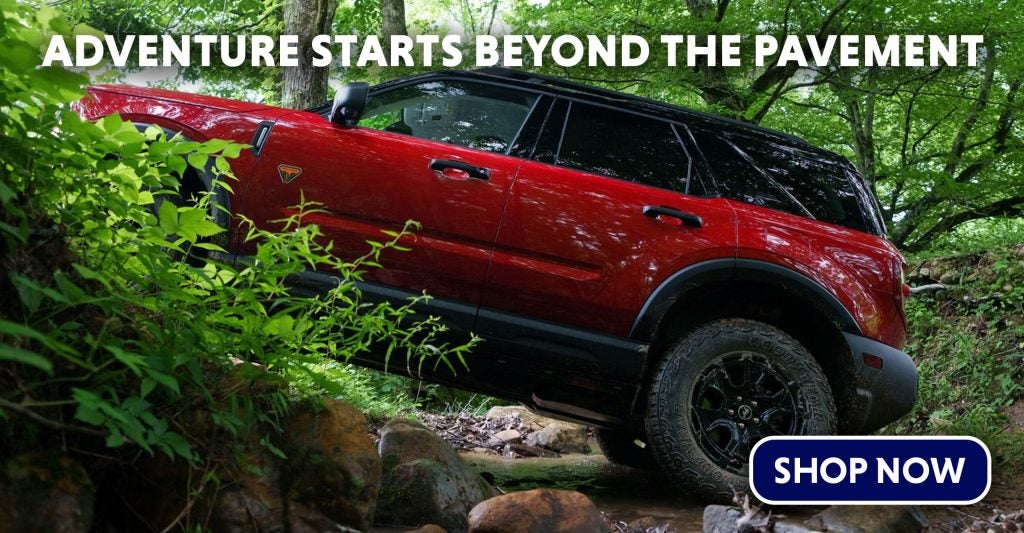
Off-road, the Ford Bronco Sport feels confident on easy trails like dirt roads, beach approaches, dry fire roads, and mild snow routes, where its compact size and traction systems make changing surfaces easier to manage. In the Ford Bronco Sport Badlands® off-road form, it can also handle some moderate trails with deeper ruts, steeper grades, loose climbs, and uneven terrain when driven carefully. At this level, ground clearance, tire strength, angles, and drivetrain heat become more important. On difficult trails, the Ford Bronco Sport reaches its limits. It is best viewed as a capable small SUV for real off-road adventures, not a vehicle built for extreme rock crawling.
Key Hardware That Drives Ford Bronco Sport Off-Road Capability
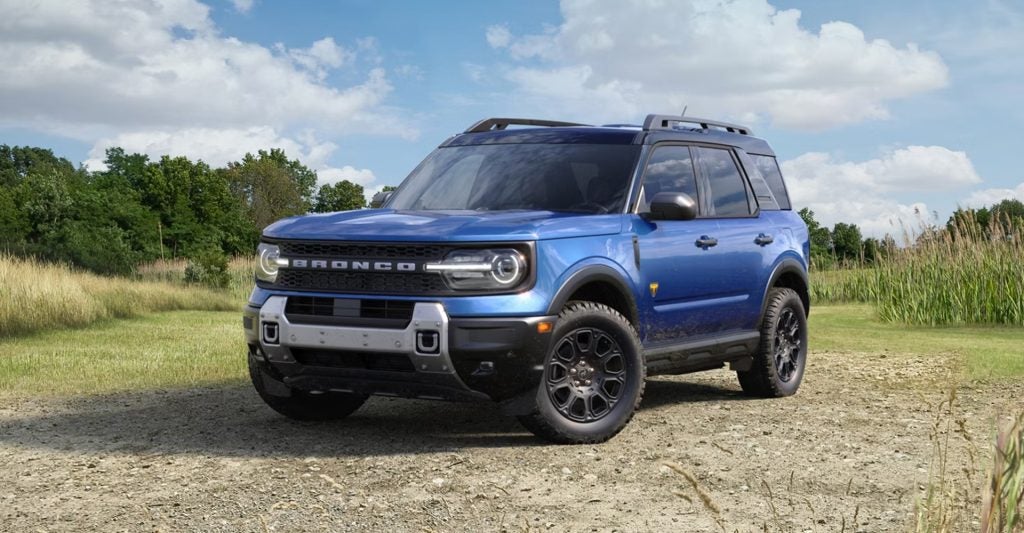
The Ford Bronco Sport’s off-road capability starts with standard 4x4 performance that helps direct torque to the wheels with the most traction on dirt, snow, and loose terrain. Advanced traction and stability systems also improve control, making off-road driving more manageable for everyday drivers.
Available skid plates and underbody protection help shield key components from rocks and rough terrain, while the compact wheelbase improves maneuverability on narrow trails and wooded paths. Together, these features give the Ford Bronco Sport practical capability for a wide range of off-road adventures.
Traction Systems and What They Do on Dirt
Brake-based traction control helps when a wheel loses contact or spins on a low-grip surface by redirecting usable torque across the axle. That matters on ruts and cross-axle bumps, where a compact crossover can lose momentum quickly if one unloaded tire spins freely. A locking rear differential, when equipped on higher trail-focused versions, changes the Ford Bronco Sport’s behavior more than many buyers expect. By forcing both rear wheels to contribute on climbs and in offset ruts, it reduces the need for aggressive throttle inputs that can create wheelspin and heat.
HOSS Suspension Basics (Why It Matters Off Pavement)
Ford’s HOSS suspension concept is designed to keep the tires in contact with the surface while reducing harsh impacts that upset the cabin and the chassis. In practical terms, that means better control on washboard roads, fewer abrupt rebounds after potholes, and more predictable grip over repeated bumps. Upgraded dampers and cooling support matter on long, rough trails because sustained impacts generate heat that can reduce damping consistency. Suspension that stays composed after an hour of corrugations is more valuable than suspension that feels impressive for the first ten minutes.
Choosing the Right Trim for Off-Road Use
Trim choice matters because the Ford Bronco Sport lineup does not deliver identical trail hardware across every model. Differences in drivetrain calibration, cooling capacity, suspension tuning, and available protection directly affect how the vehicle handles repeated off-pavement use. For occasional dirt roads and mild weather, a lower trim level can be enough if it has suitable tires and a careful driver behind the wheel. For frequent trail use, steeper grades, or mixed terrain, the Ford Bronco Sport Badlands® is the more educationally sound recommendation because it adds meaningful mechanical margin rather than cosmetic attitude. That distinction is important for buyers who confuse appearance packages with capability packages. The right trim is the one matched to terrain frequency and difficulty, not the one with the most aggressive look in a parking lot.
Ford Bronco Sport Badlands® Off-Road: What Makes It Different
The Ford Bronco Sport Badlands® off-road configuration is the most trail-focused version, pairing the 2.0L EcoBoost® engine with Advanced 4x4 and a twin-clutch rear-drive unit. That rear hardware improves torque distribution side to side, helping the vehicle maintain forward progress on uneven surfaces or when one rear wheel is lightly loaded. The Ford Bronco Sport Badlands® also features seven G.O.A.T. Modes® and standard off-road-friendly equipment, including underbody protection and trail-oriented wheel and tire choices. Those additions matter because they improve both the vehicle’s ability to keep moving and its ability to survive terrain contact.
G.O.A.T. Modes® Explained: How to Use Them on Real Trails
G.O.A.T. Modes® change more than dashboard graphics because they alter throttle response, transmission behavior, AWD engagement, and traction-control thresholds. That means the selected mode affects how the Ford Bronco Sport puts power down, how quickly it shifts, and how much wheel slip it allows before intervening.
The practical rule is simple: choose the mode that matches the surface, then drive smoothly enough that the system can help rather than react to mistakes. Electronics improve consistency, but they cannot fix poor line choice, excessive speed, or repeated full-throttle wheelspin.
Drivers who understand this usually get more from the Ford Bronco Sport than drivers who assume the mode selector does all the work. Terrain modes are force multipliers for good technique, not substitutes for it.
Mode-by-Mode Quick Guidance (Mud, Sand, Snow, Rock, Normal)
Mud and ruts mode works best when you maintain steady momentum and avoid abrupt steering inputs that scrub speed. It is useful where the surface is soft enough to drag the tires but not so deep that the vehicle is plowing with the underbody.
Sand mode favors smooth throttle and uninterrupted movement because stopping can make restarting difficult. Lower tire pressure can help in appropriate conditions, and keeping the wheels straighter during launch reduces the tendency to dig.
Snow mode is most effective when paired with winter-rated or capable all-terrain tires because tire compound determines cold-grip performance more than the badge on the tailgate. Rock-focused settings, where available, help with slow-speed control, while Normal remains the right choice for mixed pavement and mild loose surfaces.
Engines and Power Delivery Off-Road
The Ford Bronco Sport offers a 1.5L EcoBoost® rated at 180 horsepower and 200 lb.-ft. of torque, plus an available 2.0L EcoBoost® rated at 250 horsepower and 280 lb.-ft. of torque. Those numbers matter less for top speed than for how much torque reserve the vehicle has when climbing, carrying gear, or moving through soft terrain. Off-road, low-speed control is more important than peak horsepower because the goal is to meter torque without breaking traction. A tractable engine with a predictable response reduces wheelspin, preserving momentum and lowering stress on tires and driveline components.
When the 2.0L EcoBoost® Makes a Practical Difference
The 2.0L EcoBoost® makes the clearest difference on steeper climbs, in deeper sand, when towing to trailheads, or when the vehicle carries heavier accessory loads. Extra torque gives the driver a larger cushion for maintaining momentum without resorting to frantic throttle inputs. That margin also improves drivability because the vehicle can stay within a calmer operating range. In practice, more torque often means less drama, and less drama usually means less heat and less trail damage.
Tires and Pressure: The Biggest Off-Road Upgrade You Can Make
If one change most improves the Ford Bronco Sport's off-road performance, it is tire selection. Ford Bronco Sport off-road tires affect traction, puncture resistance, braking distance, ride compliance, and sidewall durability more directly than most accessory parts.
For most drivers, all-terrain tires are the best all-around choice because they balance dirt grip, road manners, wet braking, and tread life. Mud-terrain tires can help in deep mud, but they usually add noise, reduce everyday refinement, and are unnecessary for the mixed-use conditions where the Ford Bronco Sport is strongest.
Pressure strategy matters because a slightly aired-down tire lengthens the contact patch and helps the tire conform to uneven surfaces. That can improve traction and ride comfort, but only when done conservatively and with a plan to reinflate before pavement speeds.
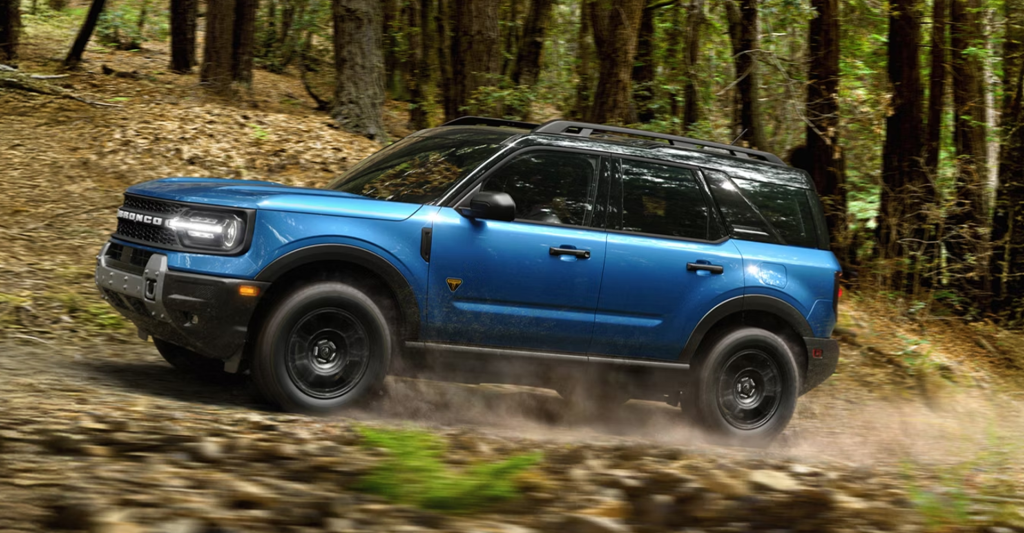
Ford Bronco Sport Sasquatch® Badlands® Package
The available Ford Bronco Sport Sasquatch® Badlands® Package adds even more confidence for drivers who frequently venture off-road. Designed specifically for tougher trail conditions, the package includes a HOSS 3.0 Off-Road Suspension, Bilstein® Position Sensitive Dampers, and an upgraded 850W engine cooling fan to improve durability and control on uneven terrain. Trail-focused features like high-clearance fender flares, steel-plated rear bumper protection, and rear D-ring recovery hooks help prepare the Ford Bronco Sport for mud, rocks, and challenging obstacles. The package also includes 17-inch Ebony Black-painted aluminum wheels wrapped in P235/65R17 all-terrain tires, a setup that balances traction, ride comfort, steering precision, and rim protection for both daily driving and off-road adventures.
Ford Bronco Sport Sasquatch® Package: What It Adds and When It’s Worth It
The Ford Bronco Sport Sasquatch® package adds traction, durability, and clearance-oriented hardware for drivers who use their vehicle regularly off-maintained roads. It is most valuable when trail frequency and trail roughness justify factory-engineered upgrades rather than piecemeal aftermarket experimentation.
The package typically includes HOSS 3.0 Off-Road Suspension, Bilstein Position Sensitive Dampers, an 850W engine-cooling fan, additional recovery hardware, and all-terrain tires. That combination matters because suspension control, cooling capacity, and recovery readiness often determine whether a long trail day stays enjoyable or becomes mechanical triage.
A practical decision rule is simple: if your driving is mostly on dirt roads and you have occasional access to campgrounds, this package may be more hardware than you need. If you regularly run moderate trails with rocks, ruts, washouts, and sustained rough surfaces, the extra margin is easier to justify.
Towing and Gear: Using the Ford Bronco Sport for Adventure Travel
When properly equipped, the Ford Bronco Sport can tow up to 2,700 lbs., making it suitable for small trailers, light watercraft, and adventure gear. However, off-road towing requires extra caution, as added weight affects braking, maneuverability, and trail control. Roof racks and safari-style storage add versatility, but heavy gear mounted high can reduce stability on uneven terrain. For the best off-road experience, keep heavier cargo low and secure, and organize frequently used gear for easy access.
Safety and Driver-Assistance Features That Help Off-Pavement
The Ford Bronco Sport’s available 360-Degree Camera with Split View can improve trail placement by helping the driver see rocks, roots, and edges hidden by the hood line. That visibility matters most in compact SUVs, where a few inches of misplacement can mean a cut tire or a scraped underbody. Systems such as BLIS® with Cross-Traffic Alert, auto high-beam headlamps, and AdvanceTrac® with RSC® are also valuable during the road-to-trail transition. The drive to the trailhead often involves fatigue, changing weather, and loaded cargo, which means safety technology still matters before the dirt begins. These features have limits, though, and that distinction is essential. Cameras do not replace a spotter, sensors do not understand every obstacle, and no driver-assistance system can judge whether an obstacle exceeds the vehicle’s physical capability.
Key Takeaways for Confident Ford Bronco Sport Off-Road Trips
The Ford Bronco Sport delivers capable off-road performance because its systems work together. Tire selection, terrain modes, suspension tuning, cooling, and smart driving habits all contribute to maintaining traction and control on challenging surfaces. Certain trims provide added confidence for drivers who frequently explore moderate trails, offering enhanced traction, improved underbody protection, and greater durability in tougher conditions.
Most importantly, successful off-road trips come down to preparation and good judgment. Drivers who inspect their vehicle, choose trails that match their equipment, and adjust to changing conditions will get the most out of the Ford Bronco Sport off-road experience.
Get started today by visiting Palmetto Ford to explore our off-road-ready Ford Bronco Sport lineup!
FAQs
Is the Ford Bronco Sport capable of off-roading?
Yes. With standard 4x4, G.O.A.T. Modes®, and the right tires, it handles dirt roads, sand, snow, and moderate trails well.
Is the Ford Bronco Sport a true 4WD?
It uses a 4x4/AWD-based system that automatically manages traction rather than a traditional truck-style transfer case. Higher trims add more advanced rear-drive hardware for better low-speed control and torque distribution.
Can I drive my Ford Bronco Sport in the snow?
Yes, if you use the correct G.O.A.T. Mode® and fit winter-rated or capable all-terrain tires. Snow performance depends heavily on tire compound and smooth driver inputs, not just drivetrain hardware.